


I use artificial intelligence every day.
I use it to draft, research, organize, and brainstorm ideas. It saves me time in real time. I won’t pretend otherwise, nor will I be threatened by it. But I also don’t let it design my clients’ vacations.
Here’s why artificial intelligence is useful and where it falls short of expectations.
Itinerary looks right.
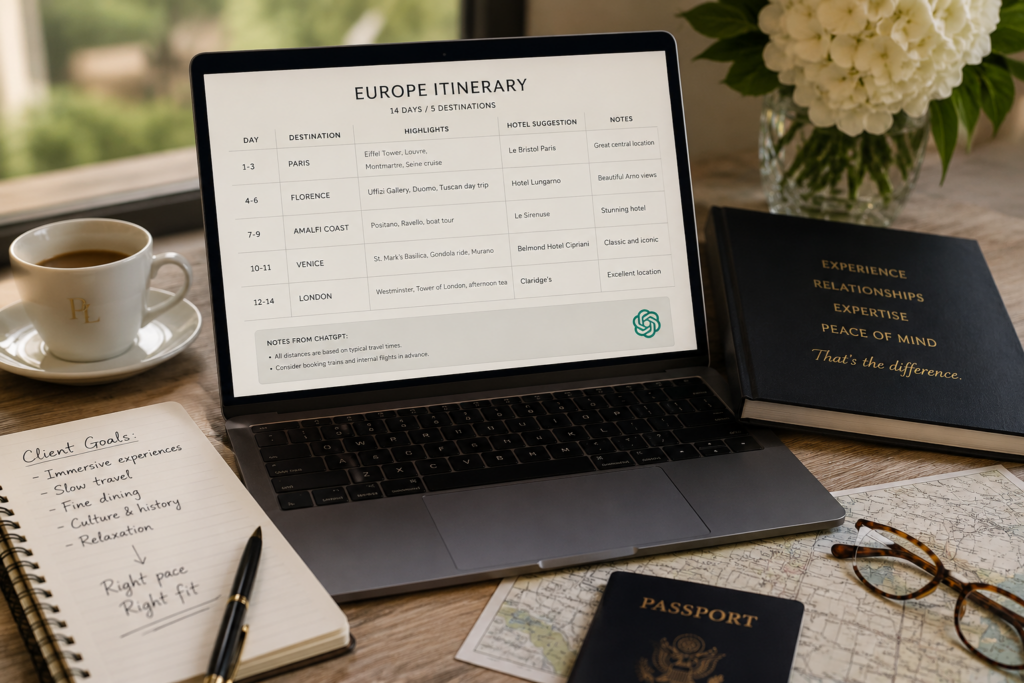
A potential client recently contacted us about a trip to Europe. She had already created an itinerary using ChatGPT and didn’t want to start over – she wanted me to review it and build from there. fair enough.
At first glance, it looks solid. Cities make sense. The recommended hotels are all very good. AI does exactly what AI is good at: gathering large amounts of information quickly.
Then I started solving it and the gap became clear.
Some of the advice simply didn’t fit her travel style. For people who like to slow down and breathe, the pace is wrong. There are some transfer dates that are not only optimistic – but impossible. If she followed this schedule, her vacation would be rushed instead of traveling.
ChatGPT didn’t fail. It does exactly what it was designed to do. The problem is that it doesn’t know she.
It doesn’t know how she travels to a destination, how much downtime she needs, or which experiences she’ll still be talking about five years later. It knows the destination. It doesn’t know the travelers it’s being asked to match experiences to. This is the difference between generating an itinerary and designing a journey.
Think of AI as a well-read intern. Fast, capable, genuinely useful – but still requires someone with experience to review the work and spot where things don’t fit.
Information is not expertise.

Artificial intelligence answers the following questions:
- What hotels are available?
- How long does the train ride take?
- What are the top rated restaurants?
- What’s the weather like in September?
it works. Worth knowing. Luxury travel revolves around a different set of issues entirely.
Is Lake Como really suitable? Or is Lake Orta more suitable for this client’s temperament? Would switching hotels every other night feel adventurous or exhausting? Are Michelin star reservations worth pursuing, or will a family-run eatery create memories that last longer than travel? Should they add a day in Tuscany and skip one in Florence?
The answers to these questions are less about search results and more about judgment. They come from experience, not search engines.
The problem has never been a problem.

One of my clients was traveling in Italy and planned to take the train from Modena to Venice. Two days before departure, my Italian destination partner contacted me: the train was cancelled.
Before my client realized there was a problem, we had an alternative planned.
He had never stood in a crowded station wondering what was going on. He never scrambles. He had just arrived in Venice. Our arrival assistant was waiting for him on the platform. Artificial intelligence could have helped him explore his options once he arrived at the station. My team fixed the problem before he could pack his bags.
Technology flagged the question. People fix it.
2 a.m. in New York.

A client flew first class to Paris via New York. At 2:00 a.m., my flight monitoring software alerted me to a severe delay on the first leg. If nothing changes, they will miss out on international connections and lose a full day off that they invested heavily in.
I immediately contacted the emergency response team at the air desk. Before most passengers realized there was a problem, we secured seats on another flight. Two hours before my client leaves for the airport, I text them. Explained the situation. Tell them what we did. Tell them they are cared for.
They walked into the airport knowing everything was taken care of. Technology told me something was wrong, but people corrected it.
No one asked for an upgrade.

Not every story is about solving some problem—sometimes it’s about predicting something important.
A client stayed at the same London luxury hotel before and after a trip to Europe. Because I spent years building relationships with the hotel’s leadership, the staff remembered them when they came back. Awaiting them was an upgrade to an executive suite and a personal welcome from the general manager.
I never asked for it either. The hotel simply wants to recognize its valued guests from a trusted partner.
That moment does not appear in any algorithm. It’s built through years of showing up, following through, and putting the right people in the right places.
What would I actually recommend?.
Use artificial intelligence. I really mean it. Ask it questions, explore ideas, and let it help you build a rough outline of your trip. This is a really useful starting point.
Then take what you’ve learned and bring it to others, whose job it is to know when the information is wrong, when the rhythm is out of whack, and when the “top rated” option doesn’t fit. youand what to do when things fall apart at 2 a.m.
Artificial intelligence generates answers. Luxury Travel Advisors are responsible for results.
When you invest tens of thousands of dollars in an experience, that difference is everything.
Shannon Lamarche is the founder of Premiere Luxury Travel and a professional consultant specializing in custom European safaris, African safaris, and small ship and river cruises. She uses artificial intelligence as a business tool and relies on more than 20 years of experience, trusted global partnerships, and first-hand destination knowledge to ensure her clients’ trips go as expected.